
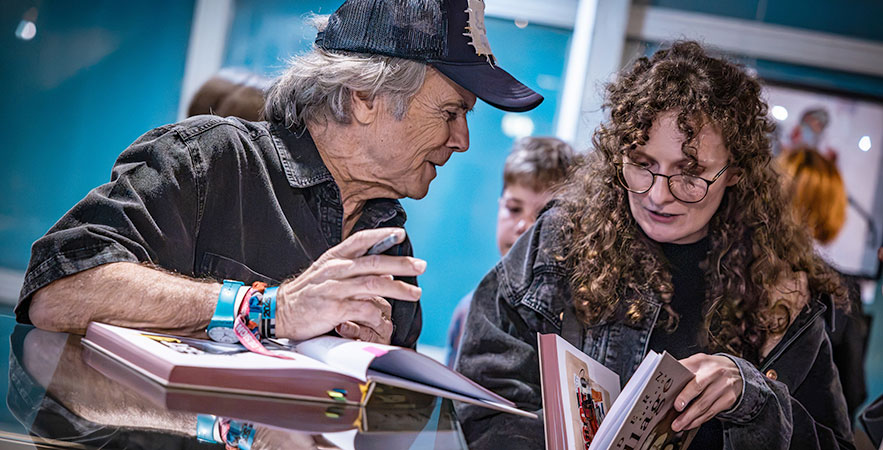
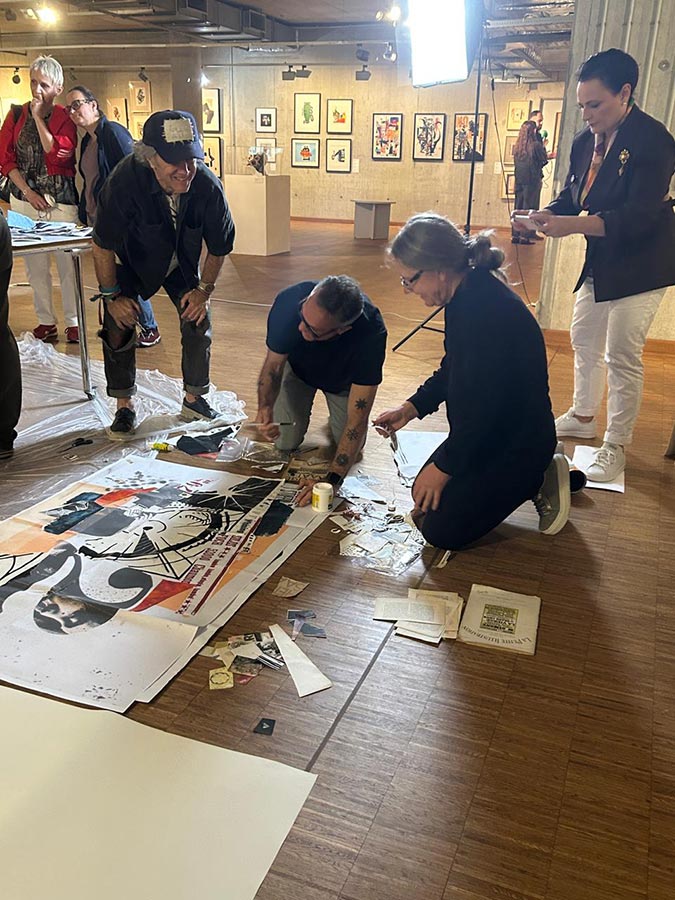
David Carson—one of the most important and influential figures in contemporary graphic design—visited Warsaw to take part in the International Collage Exhibition Warsaw 2026, organized by Retroavangarda. The day after the exhibition’s opening, Carson joined Brazilian artist Marcos Mello to create a live collage at Gallery Dobra, located within the University of Warsaw Library.
For the international graphic design community, David Carson’s presence in Warsaw was an exceptional event. The artist, who revolutionized the way designers think about typography and visual communication in the 1990s, is now regarded as one of the most recognizable icons of contemporary design.
Creative Review has described him as “the world’s most famous graphic designer,” while Graphic Design USA ranked Carson among the five most influential designers in history. In 2014, he received the AIGA Medal, one of the highest distinctions in American graphic design, awarded in recognition of outstanding contributions to the advancement of visual communication.
Carson is also the recipient of more than 230 international awards. Apple recognized him as one of the thirty most influential Macintosh users in the company’s history. His landmark publication, The End of Print: The Graphic Design of David Carson (1995), became one of the most influential and best-selling books ever published on graphic design.
The Designer Who Broke the Rules
Born in 1954 in Corpus Christi, Texas, David Carson is remarkable not only for his work but also for his unconventional artistic journey. Trained as a sociologist, he spent many years as a professional surfer before turning to graphic design. Surfing—with its rhythm, unpredictability, constant movement, and demand for intuitive decision-making—became one of the defining influences on his distinctive approach to design.
In the 1990s, Carson achieved international recognition as art director of the influential music magazine Ray Gun. His work became a symbol of a new visual aesthetic. He rejected conventional typographic order, rigid grids, and the principle of absolute readability. Letters began to function as images: they were distorted, layered, stretched, fragmented, and treated as elements of expressive composition.
This gave rise to one of the most distinctive visual languages of the 1990s, associated with grunge typography.
Carson demonstrated that graphic design does not have to function solely as a tool for conveying information. It can be an experience. It can evoke emotions, create tension, disorient, surprise, and leave room for the viewer’s individual interpretation.
His approach had an enormous influence on subsequent generations of designers and artists. Carson has collaborated with some of the world’s leading brands, including Nike, Pepsi, Microsoft, Levi Strauss, and Giorgio Armani, but his significance extends far beyond commercial design.
Collage as the Most Personal Form of Expression
Collage occupies a special place in Carson’s creative practice.
It is through collage that a designer can fully free himself from functional requirements, briefs, and the constraints of commercial communication. What remains is image, material, rhythm, chance, and intuition.
In her book accompanying the International Collage Exhibition — Warsaw 2026, the exhibition’s curator, Dr. Anna Kłos, emphasizes the particular significance of this aspect of Carson’s work:
“In his collages, Carson achieves his greatest freedom — this is where design and art merge into a single gesture, and the image becomes an autonomous form of expression.”
His collages are spaces of controlled chance. At first glance, they may appear spontaneous and improvised, yet beneath their apparent chaos lies an extraordinary sensitivity to rhythm, proportion, and visual tension.
Carson frequently incorporates found typographic elements, fragments of printed matter, traces of urban space, and imperfections resulting from the printing process. What might be regarded as an error in conventional design — a misalignment, smudge, imperfection, or accidental mark — becomes part of his artistic language.
In this sense, his work remains close to the spirit of Dada: chance is not an error, but a method for generating new meanings.
David Carson at the International Collage Exhibition — Warsaw 2026
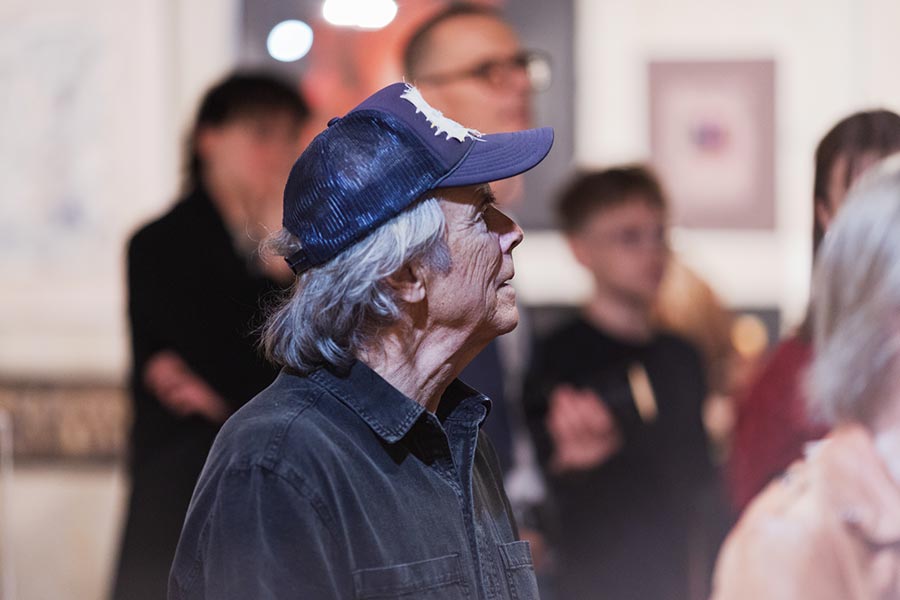
David Carson’s presence was one of the highlights of the International Collage Exhibition — Warsaw 2026, organized by Retroavangarda and curated by Dr. Anna Kłos.
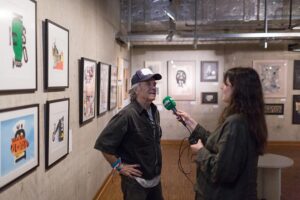
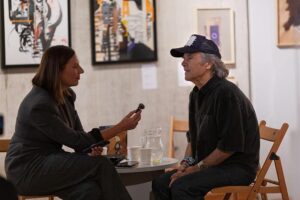
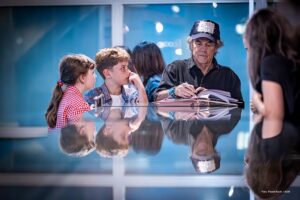
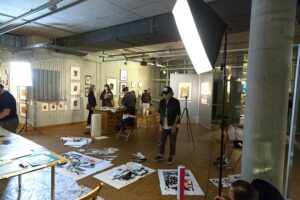
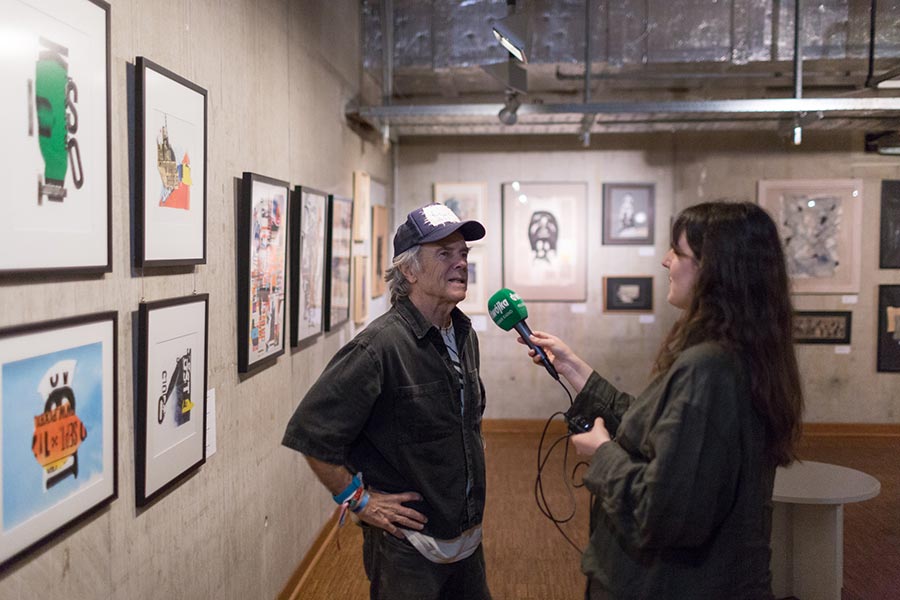
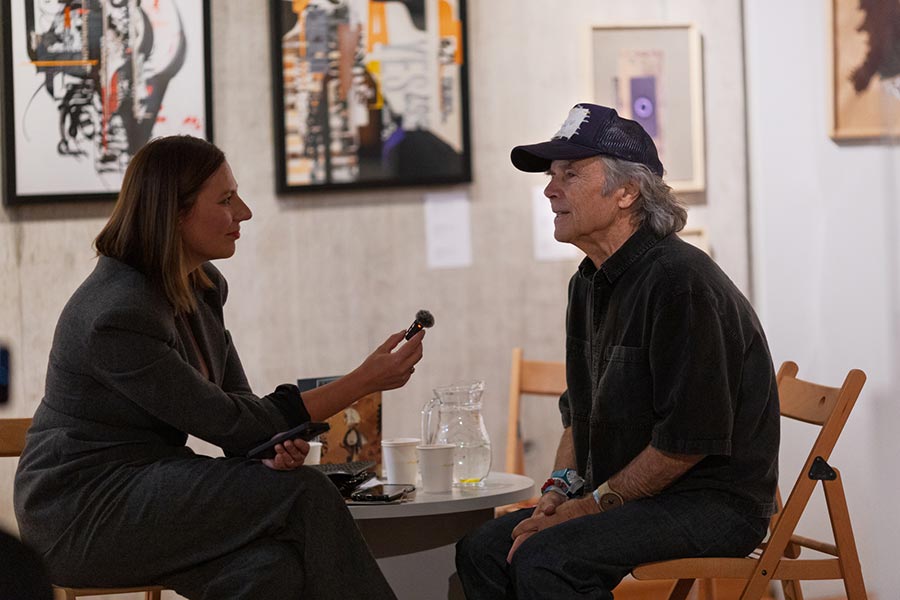
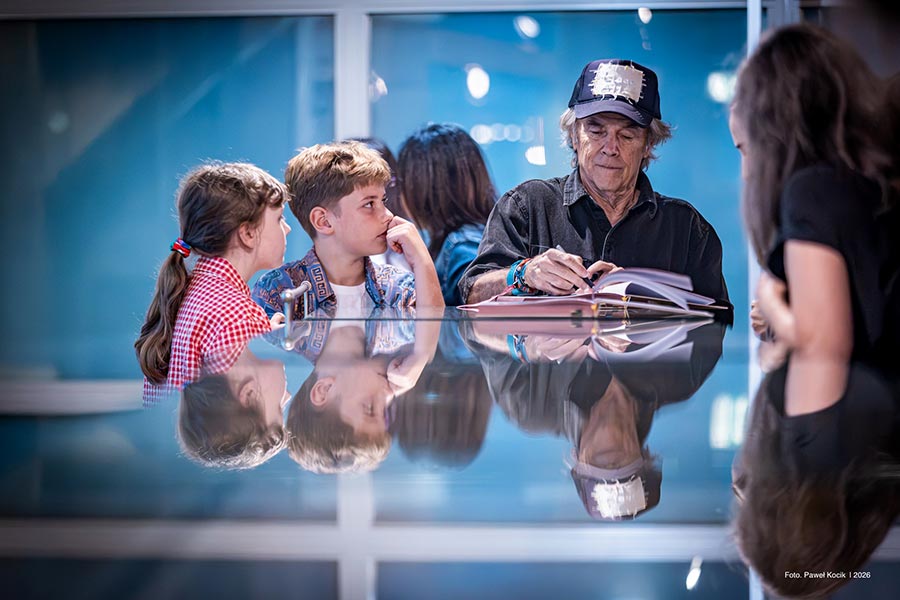
David Carson at the International Collage Exhibition in Warsaw 2026
The exhibition opened on 9 July 2026 at Galeria Dobra in the University of Warsaw Library. It presents the work of artists from different countries, highlighting contemporary collage as an exceptionally diverse and dynamically evolving field of artistic practice.
Carson came to Warsaw in person, presenting his collages as part of the international project. His participation was particularly significant because his work perfectly reflects the central idea of the exhibition: crossing the boundaries between art, graphic design, typography, and experimentation.
The International Collage Exhibition thus became not only a presentation of finished works, but also a space for encounters between different generations, cultures, and approaches to the image.
Carson and Marcos Mello — A Live Collage Collaboration
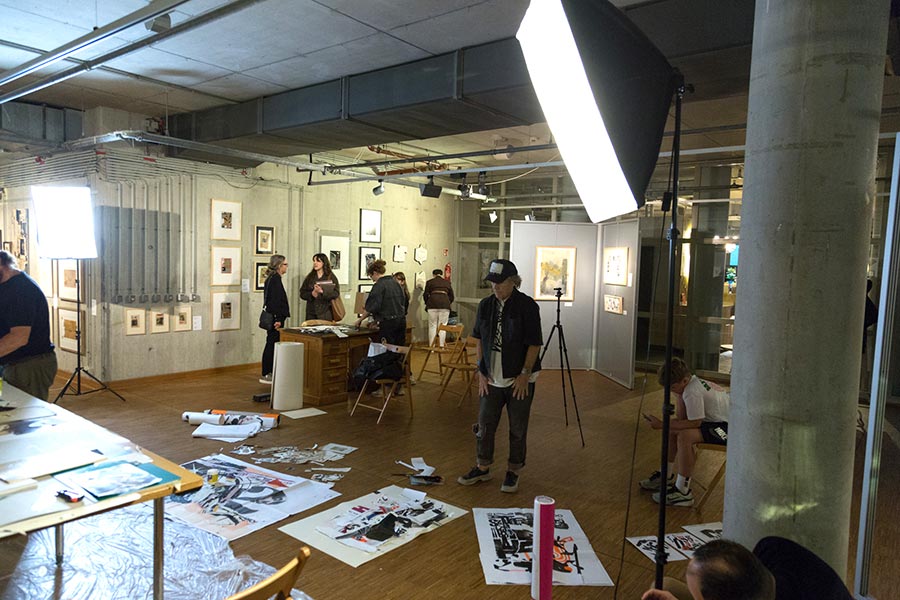
An especially important part of David Carson’s visit to Warsaw was an event held on 10 July 2026, the day after the exhibition opening. Carson met Brazilian artist Marcos Mello to create a collage together live.
Mello is an artist, designer, and educator whose practice is rooted in traditional printing techniques, letterpress, and, in particular, experimental typography. The meeting of two artists representing different experiences, cultures, and working methods created a unique artistic situation.
Carson brought to the process his intuitive and expressive approach, characterized by his interest in typography, chance, and fragments. Mello contributed his experience with the physicality of materials, printmaking, structure, and traditional craftsmanship.
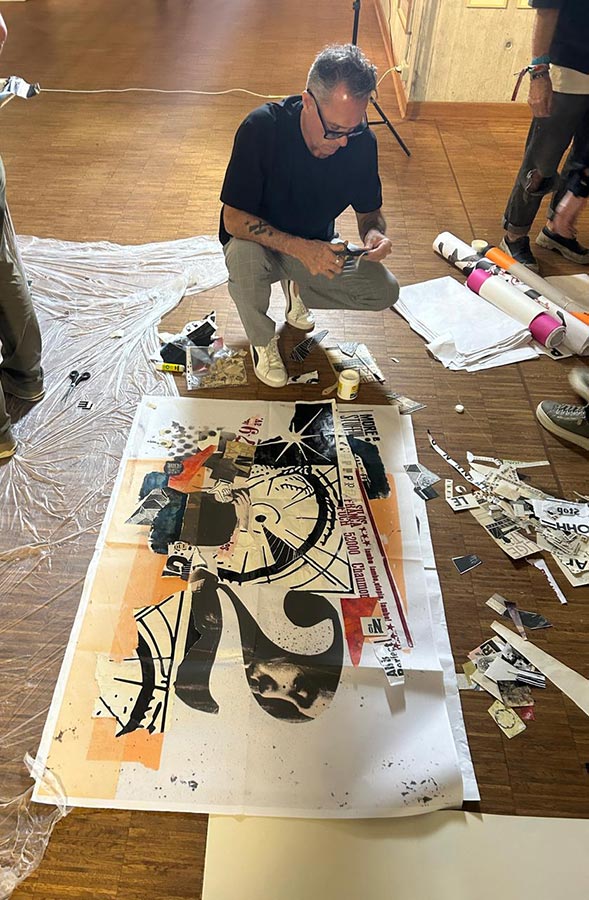
During the event, the collage was created in real time, becoming a record of the creative process — of decisions, experiments, changes, and the artists’ responses to one another.
It was through this direct act of creation that the shared space between graphic design and collage art became particularly apparent.
Paper, typography, texture, and chance began to function as elements of a visual dialogue.
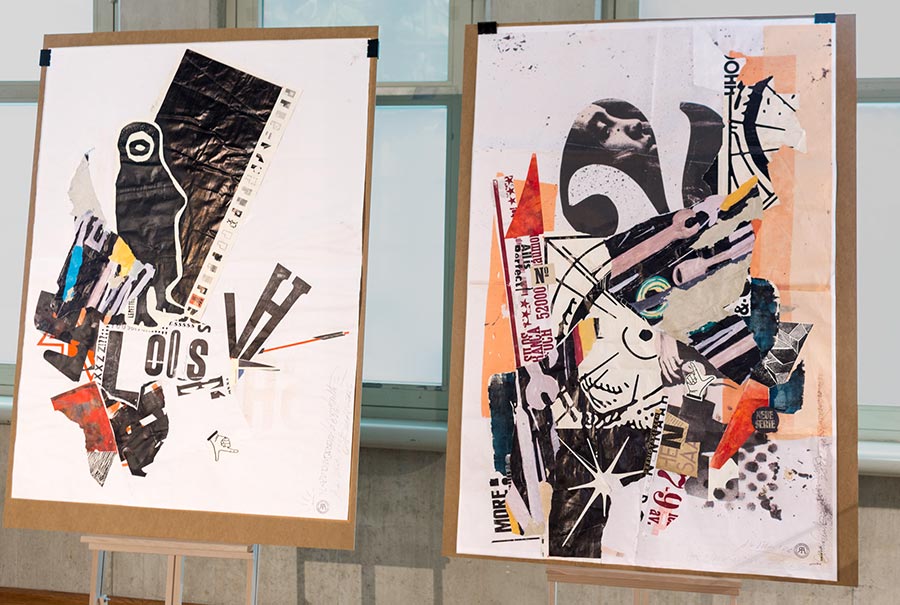
The collaboration resulted in two original collages created jointly by David Carson and Marcos Mello.
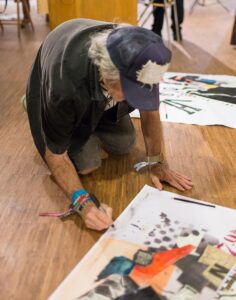
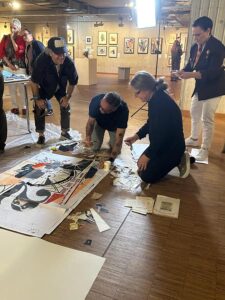
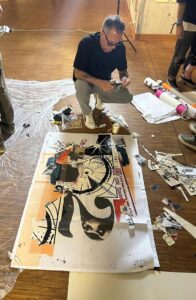
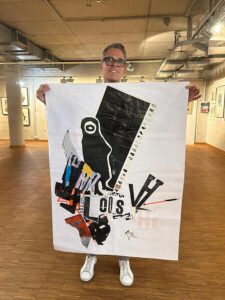
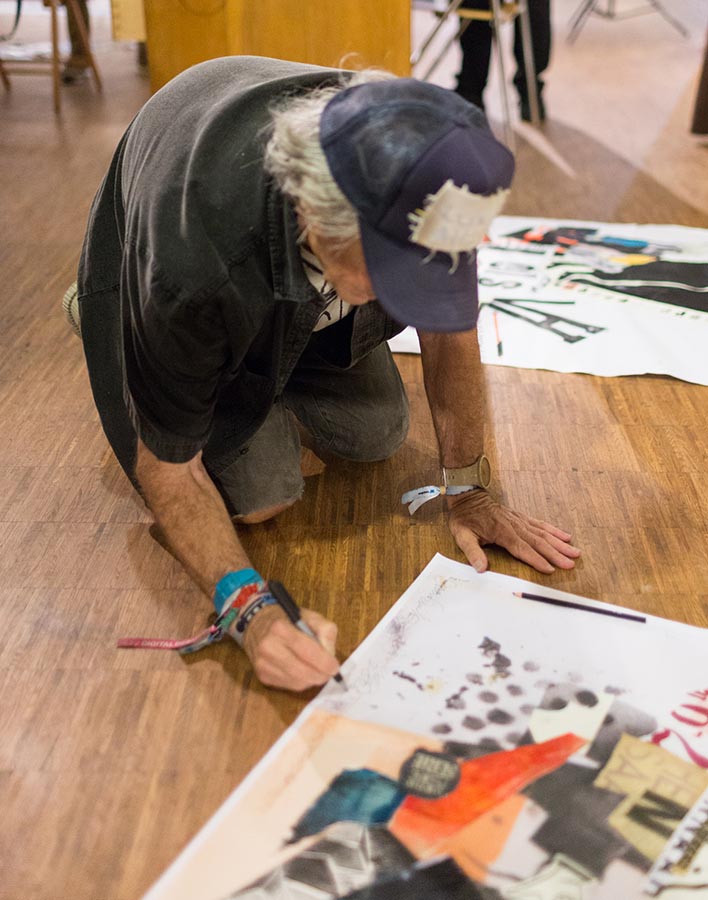
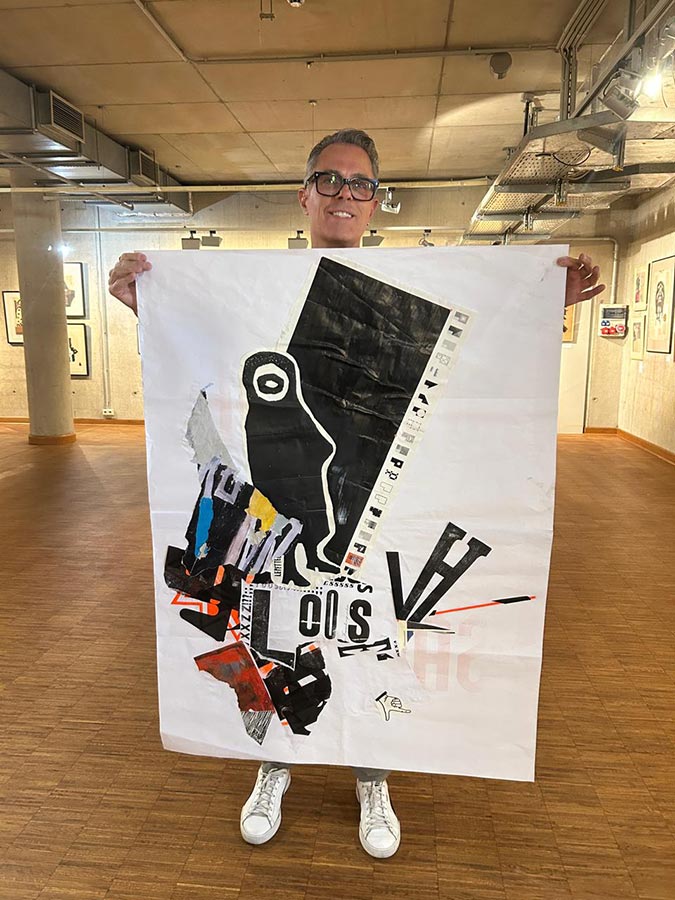
David Carson (USA) & Marcos Mello (Brazil)
Artistic Collaboration
10 July 2026, Galeria Dobra, University of Warsaw Library
The resulting works are not only autonomous artworks, but also records of an exceptional encounter between two artists and two different traditions of thinking about the image.
Design as Intuition, Collage as Freedom
David Carson’s visit to Warsaw carried a significance that extended beyond the presence of a renowned designer at an international exhibition.
For decades, Carson has demonstrated that design does not have to be governed solely by rules, functionality, and technology. His work is rooted in the belief that intuition, emotion, chance, and personal gesture can be just as important as systems and precision.
Contemporary collage is a natural field for this kind of experimentation. In a world of increasingly ordered and algorithmically controlled images, his work reminds us that the most compelling solutions often emerge when the creator allows room for risk.
The Warsaw exhibition created a space in which this philosophy could meet the work of dozens of artists from around the world.
And the collaborative work of Carson and Marcos Mello revealed something more: collage is not merely a finished image. It is also a process, an encounter, and a dialogue.
International Collage Exhibition — Warsaw 2026
Organizer: Retroavangarda
Curator, initiator and lead organizer: Dr. Anna Kłos
Main venue: Galeria Dobra, University of Warsaw Library, 56/66 Dobra Street, Warsaw
Opening: 9 July 2026, 6:00 PM
Main exhibition: 9 July – 30 August 2026
Accompanying exhibition: Retroavangarda Gallery, Warsaw, 11 July – 30 September 2026
Live event: David Carson & Marcos Mello — 10 July 2026
Venue: Galeria Dobra, University of Warsaw Library
The International Collage Exhibition — Warsaw 2026 is a Retroavangarda project dedicated to contemporary collage.